
Choosing the right preschool backpack: size, fit, and features
The short answer: A daycare backpack is right if it sits close to the back, the shoulder straps are adjustable, nothing presses against the child, and they can open and close it themselves. Choose the volume based not just on age, but on the actual daily contents: lunchbox, water bottle, a change of clothes, and whatever your daycare specifically requires. A small backpack is often better than a large one that gets unnecessarily packed full.
Choosing a daycare backpack: the decision in 30 seconds
What really needs to go with them every day? Make the packing list first, then choose the size.
Test it with a thin top and a jacket. The backpack must not slip or rub against the neck.
Your child should ideally be able to operate the zipper, buckle, and compartments themselves.
A side pocket, chest strap, care instructions, and clearly visible details can be more important than an extra compartment.
What size daycare backpack do you need?
The right size depends on what the backpack needs to hold and how it fits the child. There is no fixed liter capacity for every age. Some nurseries provide drinks and meals, while others expect a lunchbox, bottle, and a change of clothes. That is why the daycare's packing list is the best starting point.
As a practical guide, a compact model around 3 to 4 liters may be sufficient if only a small lunchbox, a narrow bottle, and a few small items are carried. For extra clothes or longer outings, models around 7 to 8 liters may make more sense. Larger models around 10 to 11 liters offer more reserve space, but should only be chosen if the child can carry them well and the space is actually needed. These ranges are a practical guide for everyday use, not a general age rule.
- Prepare the lunchbox, water bottle, and change of clothes.
- Pack only these items in the backpack.
- Check if there is still some room without hard objects pressing against the back.
- Let your child walk around for a few minutes, bend over, and move their arms.
How a children's backpack should fit
A good fit is more important than a particularly large interior volume. The backpack should be worn close to the body. Both shoulder straps must be adjusted similarly; wearing it on one side is not a good solution for everyday use. The German Statutory Accident Insurance recommends that school backpacks fit well over both a T-shirt and a thick jacket and do not slip off the shoulders. This fitting principle is also useful for a daycare backpack.
What to look for during the fitting
- The top edge does not press against the back of the head.
- The backpack does not hang far below the back.
- The straps do not dig into the neck and do not slip off the shoulders.
- The child can walk normally, move their arms, and sit down.
- The packed backpack does not tilt sharply backward.
A chest strap can help keep the straps in place on narrow shoulders. It is not a substitute for the correct basic adjustment. Also check that the buckle can be easily undone and sits in a comfortable position.
Compartments, closures, and material: What matters in everyday use
Storing the water bottle separately
A side pocket or a separate bottle compartment helps keep moisture away from clothes and the lunchbox. The bottle should be leakproof and not sit so loosely that it falls out while walking.
A closure the child understands
A zipper, drawstring, Velcro, or buckle can work. The key is whether your child can operate the mechanism independently. Test this not only empty, but also with a lightly packed backpack and a jacket.
Care that suits your family's everyday life
Water-repellent does not automatically mean waterproof. Therefore, check the specific manufacturer's information and care instructions. A wipe-clean outer material is practical, while more delicate fabrics may require more care.
Think about visibility
Anyone out and about in the morning or late afternoon should choose clearly visible clothing and bags or add suitable reflective elements. The DGUV points out that bright and retroreflective components help with visibility in poor lighting conditions.
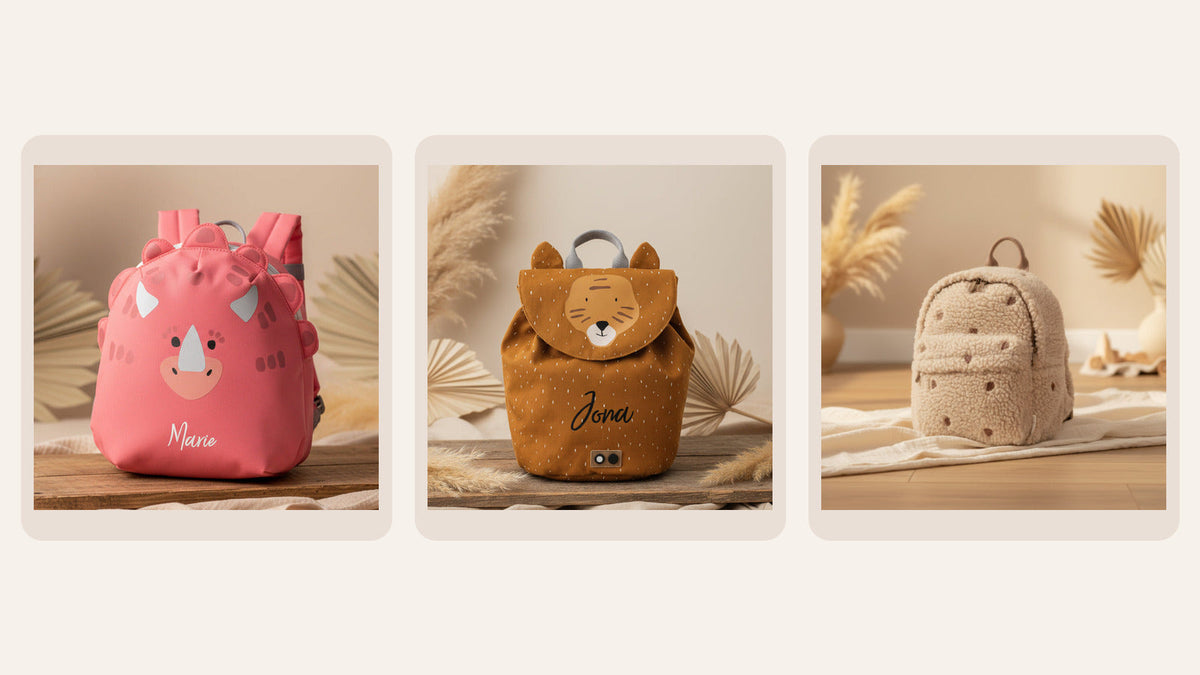
The following models were active, publicly accessible, and available in at least one version during our review. The product page with manufacturer information remains authoritative for dimensions, material, age recommendations, and care.


View all available children's backpacks
Five typical bad purchases
- Buying too large for growth: A large backpack invites you to pack too much and may fit poorly.
- Deciding based only on the motif: A favorite animal is nice, but it doesn't replace a suitable strap length and practical compartments.
- Trying it on empty: Only with a realistic load can you see if the backpack tilts or presses.
- Not testing the closure: A pretty closure can be frustrating in daycare if small hands cannot operate it.
- Overlooking care instructions: Not every material is dishwasher-safe. Read the manufacturer's information before the first wash.
Conclusion: Needs first, then motif
Choosing the right daycare backpack does not mean buying the largest or most eye-catching model. The key is a realistic packing list, a close fit, adjustable straps, and a closure the child can operate as independently as possible. Then, choosing the favorite motif or personalization combines everyday practicality with genuine anticipation for daycare.
Frequently asked questions about daycare backpacks
How many liters should a daycare backpack have?
There is no fixed liter capacity for every age. For a small amount of contents, 3 to 4 liters may be sufficient; with a change of clothes or for outings, more volume may make sense. The key is the packing list, body size, fit, and manufacturer's information.
Does a daycare backpack need a chest strap?
A chest strap is not mandatory for every child, but it can help stabilize the shoulder straps on narrow shoulders. It should be easy to operate and sit comfortably.
How do I know if the backpack is too large?
Warning signs are slipping straps, contact with the back of the head, hanging down sharply, a pulled-back posture, or restricted arm movement. Then a smaller model should be tested.
What belongs in the daycare backpack every day?
This is determined primarily by the daycare. Often it is a lunchbox, a leakproof water bottle, and, if necessary, a change of clothes. Only include medication or special care products after consulting with the facility.
Is a personalized backpack useful?
A name makes it easier to identify. For publicly visible areas, the first name is usually sufficient; further contact details are better kept inside. Pay attention to the information about personalization and returns on the product page.
Should the water bottle be inside or outside?
A suitable side pocket is practical because it keeps the bottle separate from the rest of the contents. Regardless, the bottle should be leakproof and well secured.
How often should you check the adjustment?
Check the straps when clothing layers change, the child grows, or the backpack visibly fits differently. A quick fit check before longer outings is also useful.
