
Activity Cube Rabbit Fine
Several simple grasping, plugging, and sliding tasks; according to the manufacturer from 12 months, optionally customizable.
View product
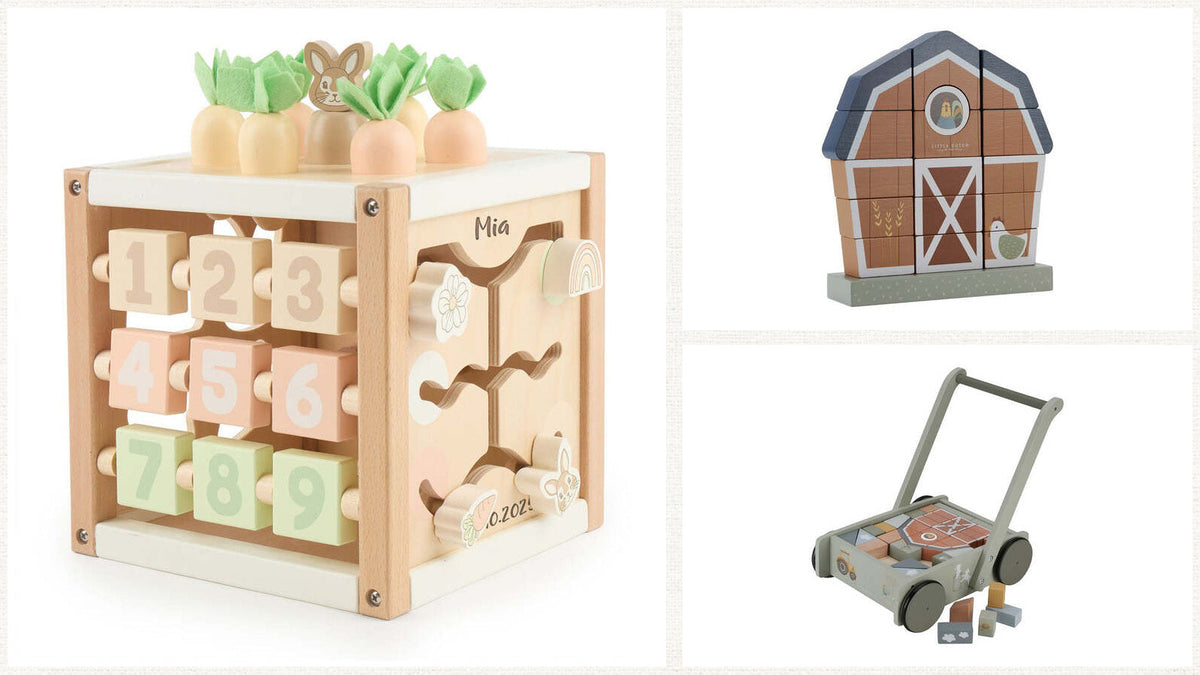
The short answer: Good motor skills toys are not just matched to the age on the packaging, but above all to what a child currently enjoys and safely experiments with. For many children from around 12 months, simple plugging, pushing, and stacking tasks are interesting. Later, sorting, building, turning, and initial balancing tasks are added. The manufacturer's age recommendation remains the mandatory lower limit.
Age groups are a guide, not a developmental roadmap. The Federal Centre for Health Education emphasizes that children develop their mobility across a broad timeframe and in different ways. Therefore, observe which movements your child already performs independently and safely. A toy should arouse curiosity, but it should neither overwhelm nor force a developmental step.
| Orientation | Typical play interest | Suitable play idea | What to look for? |
|---|---|---|---|
| from 12 months | grasping, pushing, inserting, knocking over | large stacking pieces, simple bead maze | large parts, stable base, short play paths |
| from 18 months | sorting, turning, repeating | shape sorters, gears, activity cubes | don't offer too many functions at once |
| from 2 years | building, combining, understanding first rules | stacking and balancing games, building ideas | keep construction low and supervise |
| 3 to 4 years | planning, varying, imaginative combining | obstacle courses, open-ended building and balancing solutions | increase difficulty gradually |
The table describes play interests, not medical milestones. The specific product labeling, the child's abilities, and safe usage are always the deciding factors.
Fine motor skills refer to small, targeted movements of the hands and fingers: grasping, turning, plugging, or stacking. Gross motor skills include larger movement sequences such as pushing, carrying, balancing, and climbing. Many toys combine both. When stacking, a child grasps precisely; when fetching the pieces, they move their entire body at the same time.
It is important to understand the word "promote" correctly: A toy does not train a child according to a plan and does not make development faster. It can create a stimulating, voluntary play opportunity. The World Health Organization describes early childhood as a phase of rapid physical and cognitive development and recommends varied daily physical activity. Free play, everyday movement, and being outside remain more important than any single product.
In this phase, clear sequences are particularly accessible: a ring is placed on a peg, a bead moves along a wire, a piece falls into an opening. A few large pieces and a clear result help to grasp the task itself. An activity cube should be stable and placed so that the child can play without dangerous pulling up.
A push walker is only useful when a child pulls themselves up independently and moves safely sideways or forwards with support. It is not a device that "teaches" walking. Please do not confuse a stable push walker with a baby walker where the child sits inside: such baby walkers are explicitly discouraged by kindergesundheit-info.
Once simple sequences are familiar, the task can offer a bit more choice. Shape sorters, gears, and small tracks invite repetition. Good toys show a logical connection and allow for several solution attempts. With a large activity cube, feel free to offer just one side initially rather than explaining all the functions at once.
Irregular stacking stones require more precise grasping, dosing, and planning than uniform building blocks. The child can lay things side by side, stack, or invent small building worlds. For balance games, the rule is: start low, keep the surface clear, and follow the manufacturer's instructions. Direct supervision is more important than a spectacular setup.
Many children now want to plan for themselves: Does the board become a bridge, the stones a path, or the cart a means of transport? Open-ended toys remain interesting because the task can change. Don't provide everything at once. Two or three combinable elements often create more focused play than a room full of toys.
All of the following products were active and available in at least one version at the time of selection. We deliberately omit prices so that the guide remains current for longer. Please always check the information on the respective product page before use.
In the collection, you will find other learning and motor skills toys for different interests and age groups.
Discover learning & motor skills toysFor toys sold in the EU, the CE marking is mandatory. It is the manufacturer's declaration that basic safety requirements are met. Nevertheless, the mark does not replace age recommendations, warnings, or your regular visual checks.
For even more gross motor ideas without a large park of equipment, read our guide Promoting movement in children. If material and durability are particularly important to you, the article Wooden Toys: Benefits and Selection will help. For a specific occasion, you can also find Gift ideas for a 2nd birthday.
The right motor skills toy is safe, understandable, and just challenging enough. Use age as a first filter and actual play interest as a second. A child who likes to stack does not necessarily need a large activity cube; a child who loves to move does not automatically benefit from a complicated obstacle course. A few well-chosen elements, free movement, and time to repeat are usually the stronger combination.
Motor play ideas exist for babies. For independent plugging, pushing, and stacking, many products carry a manufacturer recommendation from 12 months. The specific labeling and the child's abilities are always decisive.
Simple, stable toys with large gripping elements and a clear effect are well-suited, such as stacking rings, short bead mazes, or straightforward plugging tasks. Avoid small parts and unnecessarily complex functions.
Fine motor skills describe targeted movements of the hands and fingers. Gross motor skills include larger body movements such as walking, pushing, and balancing. Many motor skills toys address both areas.
No. An activity cube bundles several tasks to save space, but it is not a must. Stacking with cups, sorting safe everyday objects, and plenty of free movement also provide valuable experiences.
A push walker can offer a child who is already standing up and walking with support a play and transport option. It should not be used to force a developmental step. Sit-in baby walkers are explicitly not recommended by specialists.
There is no fixed number. Observe the usage: If little focused play occurs, reduce the selection to a few different tasks and swap them out after a while.
Look for the CE mark, complete manufacturer details, clear age and safety warnings, undamaged surfaces, and understandable instructions. Check the toy regularly and stick to the intended use.


