



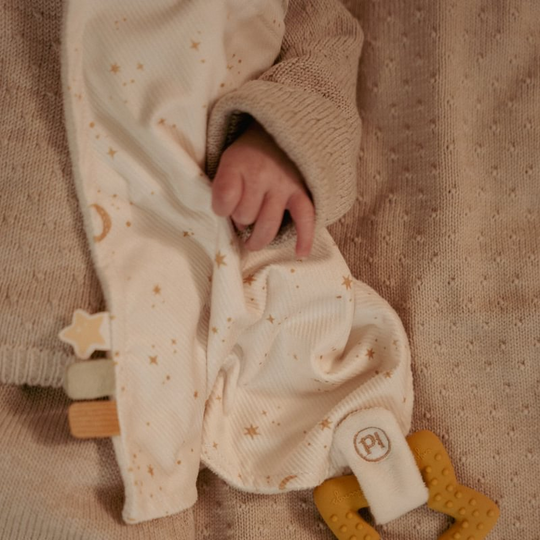


























U record & mother pass cover Twill Sand
A simple document cover for families who want to keep the U record and mother pass together and protected; optionally with personalization.
View cover

Direct answer: During the U1 examination, immediately after birth, it is checked whether the baby has coped well with birth and whether there is a condition that needs to be treated immediately. The breathing, heartbeat, skin color, muscle tone and reflexes are checked above all else. The baby is also checked for externally visible malformations or birth injuries, umbilical cord blood can be tested for its pH value and the baby's initial body measurements are recorded. The results are entered into the yellow child health record.
| Question | Short answer | What parents should know |
|---|---|---|
| When? | Immediately after birth | The initial assessment begins within the first few minutes. |
| Where? | Usually in the delivery room, birth center or at home | The place of birth determines the organizational process. |
| Who? | Doctor, midwife or obstetric nurse | If there are any abnormalities, further medical help will be sought without delay. |
| Why? | To identify conditions requiring immediate treatment | The U1 is not a general "health grade", but a medical snapshot. |
| Documentation? | In the yellow record | The record accompanies the child through the further U examinations. |
The U1 is deliberately compact and focused on the essentials. The team closely monitors the newborn, checks vital functions and responds if support is needed. The exact process may vary slightly depending on the place of birth and the condition of the mother and child.
The Apgar score summarizes five immediately observable characteristics: breathing, pulse, muscle tone, appearance and reflexes. Each characteristic is assessed so that the birth team can systematically monitor changes in the first few minutes. The score helps determine whether the baby only needs warmth and observation or additional help.
What is important for parents: A single number does not tell the whole story of a birth. What matters is the professional assessment of the team and how the baby develops in the first few minutes. If you do not understand the entry later, ask the documentation to be explained to you instead of interpreting individual values yourself.
Newborns initially have only small vitamin K stores. Vitamin K is important for blood clotting. Therefore, after consultation, parents are offered vitamin K administration to prevent rare but dangerous bleeding. The healthcare professional will explain the recommended procedure to you and document the administration.
Many examinations are grouped together in everyday language as "the tests after birth". For realistic preparation, it is worth separating them:
Depending on the discharge time, individual screenings may take place still in the maternity clinic or later as an outpatient appointment. Ask specifically before discharge what has already been done, what is still outstanding and who will arrange the next appointment.
Whether and how the U1 can be carried out during the first skin contact depends on the condition of the baby, the mother and the procedures at the place of birth. If the newborn is stable, you can ask the team early on about the quietest possible process. If the baby needs medical help, this care takes priority. This is not a failure of bonding, but protection.
A good birth plan can record wishes for the initial period, but remains flexible. In our guide Writing a birth plan: Checklist for your wishes, you will find wording that leaves room for medical decisions.
For the U1 itself, you do not need any special equipment. Clear questions and a brief organizational handover are more helpful:
For the first outpatient appointment, our Checklist for the first pediatrician appointment with baby is also helpful. It covers the next search intention and complements this U1 process without repeating it.
The medical core comes first. Once the first few days become quieter, many families like to collect the U record, cards and small keepsakes neatly. These four currently available products suit different needs without being part of medical care:
A simple document cover for families who want to keep the U record and mother pass together and protected; optionally with personalization.
View cover
For photos and short memories from the first year. Useful if parents prefer to capture moments rather than write an extensive diary.
View milestone cards
Several small compartments help to keep the birth card, name band, photos and other keepsakes separate.
View memory box
A blue-natural color variant for small memories from babyhood and the start of the family; also with organized individual compartments.
View memory boxNo. The U1 is the immediate initial examination. Hearing tests, metabolic screening, cystic fibrosis screening and pulse oximetry have their own procedures and timeframes.
No. The Apgar score describes the condition in the first few minutes. The further screenings specifically look for illnesses that are not necessarily visible from the outside.
Usually not. The U1 is part of the care directly at the place of birth. You mainly need to organize the next steps if you go home early.
The U1 answers a central question immediately after birth: Does the baby need medical support now? For this, vital functions are monitored, the Apgar score is recorded, the baby is examined, and initial measurements are recorded. Parents do not have to "do" anything for this. It is only useful to have the process explained to you and to know before discharge which screenings and appointments follow next.
The U1 begins immediately after birth. Initial observations take place within the first few minutes; the process depends on the condition of the baby and the place of birth.
The initial examination can be performed by a doctor, midwife or obstetric nurse. If there are any abnormalities, further medical help will be sought.
Breathing, pulse, muscle tone or muscle tension, appearance or skin color and reflexes are assessed. The observation usually takes place after one, five and ten minutes.
Blood from the umbilical cord can be tested to determine the pH value. The later extended newborn screening uses its own blood sample and is not equated with the U1.
Parents are offered vitamin K administration after consultation to prevent bleeding. Ask the care team to explain the benefits and the intended process.
The yellow child health record is handed over after birth by the maternity ward or the midwife. The U1 and the subsequent early detection examinations are documented in it.
The U2 is intended for the 3rd to 10th day of life. In case of early discharge, it should be clarified in good time where it takes place and which screenings are still outstanding.
Professionally checked using official information, accessed on October 8, 2026:
