
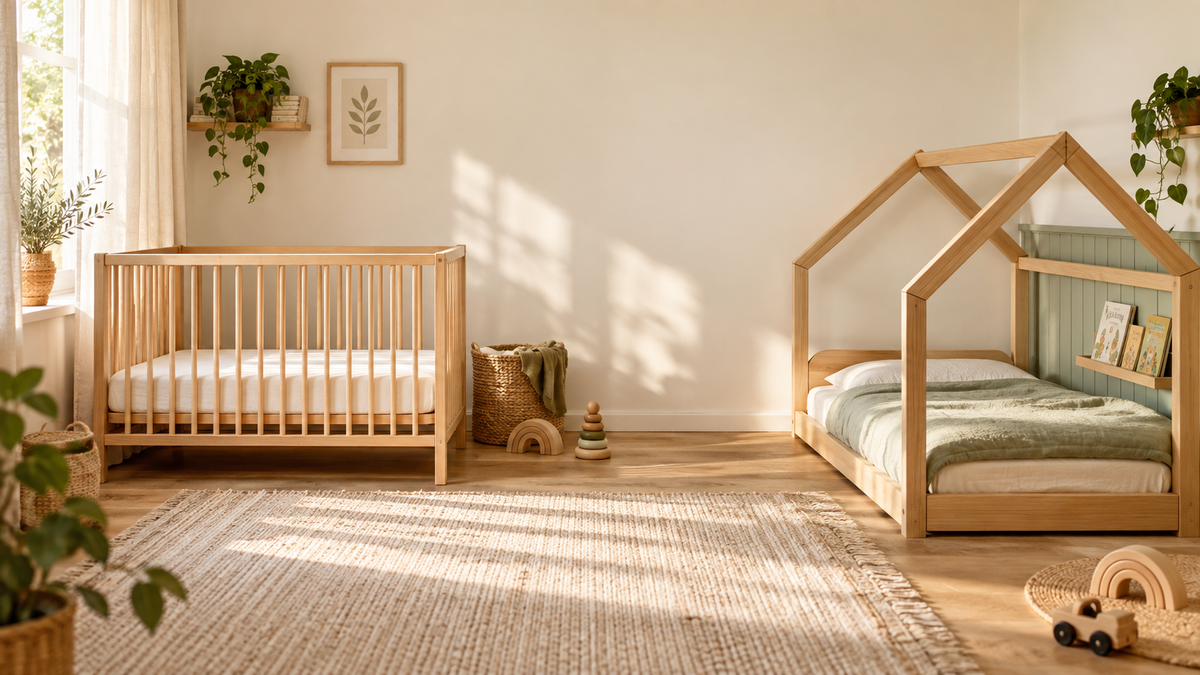
Which crib for which age? The safe guide
Which bed is right for which age? The short answer: age alone does not determine it. Height, motor development, nighttime behavior, and the manufacturer's specifications are at least as important. This guide takes you from bedside cribs and cribs to floor beds and house beds, and finally to high beds and teen beds.
A quick overview
- 0 to about 6 months: Bedside crib – only as long as size, weight, and mobility remain within the manufacturer's limits.
- From birth through toddlerhood: Crib or toddler bed – many models can be used for longer and some are convertible.
- Often from about 18 months to 3 years: Low floor bed, house bed, or toddler bed – when the child can safely get in and out.
- From about 3 years: Low toddler bed with a suitable fall protection rail; 90 × 200 cm can be chosen directly for long-term use.
- At the earliest from 6 years: High bed or upper level of a bunk bed.
- From school age to the teenage years: 90 × 200 cm is the common, long-lasting standard size; extra width is a matter of comfort.
Important: Age recommendations are guidelines. Always follow the assembly, mattress, and age requirements of the specific bed.
Which toddler bed for which age? Overview
| Phase | Suitable bed type | What matters | Typical size |
|---|---|---|---|
| Newborns | Bedside crib or crib | Proximity, firm flat mattress, free sleeping area | e.g. 40/50 × 90 cm or 60 × 120 cm |
| Baby | Crib or toddler bed | Lower the bed base in time, no climbing aids in the bed | 60 × 120 or 70 × 140 cm |
| Toddler | Convertible bed, low toddler or floor bed | Safely getting in and out independently, low fall height | 70 × 140 to 90 × 200 cm |
| Preschooler | Low toddler or house bed | Fall protection rail matching the mattress height | 90 × 200 cm |
| From about 6 years | Single bed, high bed if necessary | High bed only if climbing safely and after manufacturer approval | 90 × 200 cm |
| Teenager | Teen or comfort bed | Consider body size, sleeping habits, and room | 90 × 200 to 140 × 200 cm |
1. Bedside crib: proximity in the first months
A bedside crib creates a separate sleeping space right next to the parents' bed. This is particularly practical in the first months because the baby remains quickly accessible. The deciding factor is not a fixed end age: as soon as the child pulls themselves up, sits up independently, becomes too big or too heavy, or reaches another limit in the instructions, the model may no longer be used in its previous function.
The sleeping surface should be firm, flat, and properly filled. For babies: as little as possible in the bed. A sleeping bag is generally the better choice than a loose blanket; pillows, bumpers, furs, and soft borders do not belong in the baby sleeping area.
2. Crib or toddler bed: flexible from birth
A classic toddler bed with 60 × 120 cm or 70 × 140 cm can be used from birth. Height-adjustable bed bases spare the parents' backs at the beginning. As soon as the baby can sit up, the sleeping surface must be lowered. Convertible models can later be continued to be used with low side panels.
The switch from the enclosed crib becomes important at the latest when a child tries to climb over the bars. Then a low, freely accessible sleeping space can be safer than the supposedly protective high sides.
3. Floor bed or house bed: when is the right time?
A low floor or house bed can support independent getting in and out. The switch often occurs between about 18 months and 3 years – but this is not a fixed rule. The child should be able to move safely in the room, and the entire children's room must be childproof at night because they can leave the bed on their own.
A house frame is initially a design element. For safety, a low entry height, stability, sufficient air circulation under the mattress, and a fall protection rail matching the mattress thickness are especially important. Cords, string lights, or loose fabrics should not be attached to the bed on their own.
4. Toddler bed with fall protection: transition without unnecessary height
For many children, a low toddler bed is the calmest intermediate step. A fall protection rail can help at the beginning, but must match the bed and the mattress. A mattress that is too high can reduce the effective height of the protection. Therefore, never decide based on a product photo alone, but check the permissible mattress height.
5. High bed: not before six years
An elevated sleeping surface is not recommended for children under six years. Only from about six years can children usually better assess dangers, the nighttime descent, and their movements. Even then, manufacturer approval, a standard-compliant side protection, a safe ladder, wall mounting, and the maximum permissible mattress height are crucial.
By the way, a lower house bed is not a high bed: the height of the sleeping surface counts for classification, not the roof shape.
6. Teen bed: when is more width worth it?
A bed with 90 × 200 cm can accompany a child for many years into adolescence. 120 or 140 cm width is not an age-related necessity, but more comfort – useful for example for taller teenagers, restless sleepers, or if the bed also serves as a reading and retreat area. Above all, check the room size, load capacity, and the right mattress.
Our currently available beds for the different phases
The following models were active and available in the Schmatzepuffer shop when this guide was created on September 23, 2026. You can see the current stock directly on the product page.


7 points that are more important than a rigid age recommendation
- Manufacturer approval: Age, weight, mobility, and mattress height from the instructions take precedence.
- Independent climbing: Anyone who climbs out of the crib usually needs a lower solution.
- Fall height: The younger the child, the more sensible a floor-level sleeping surface.
- Mattress fit: No problematic gaps may form between the mattress and the frame.
- Air circulation: Even a floor bed needs a construction that prevents moisture under the mattress.
- Childproof room: For freely accessible beds, furniture must be secured, outlets protected, and dangers removed.
- Development instead of comparison: An early bed change is not a developmental advantage.
Frequently asked questions about the right toddler bed
Which bed is suitable for a newborn?
A suitable bedside crib, cradle, or standard-compliant crib can be suitable. Important are a firm, flat mattress, back sleeping, and a free sleeping area without pillows, bumpers, or loose soft items.
When is a child too big for the bedside crib?
As soon as a manufacturer's limit is reached – for example, body height, weight, or a new motor skill like sitting up or pulling up. The operating instructions are more binding than a blanket monthly recommendation.
From what age can a child sleep in a floor bed?
Many families switch between about 18 months and 3 years. The deciding factor is that the child can safely get in and out and the entire room is secured for unsupervised nighttime movement.
Is a house bed automatically a Montessori bed?
No. A house shape alone does not make a Montessori-oriented floor bed. The deciding factors are the low, independently accessible sleeping surface and an environment that enables the child's safe independence.
From what age is a high bed sensible?
At the earliest from about six years. Younger children should not sleep on an elevated sleeping surface. Even after six years, manufacturer specifications and individual maturity remain crucial.
Which bed size lasts the longest?
90 × 200 cm can be used by many children from toddlerhood well into adolescence. Whether a direct switch makes sense depends on entry height, protection, room, and sleeping habits.
Conclusion: The best toddler bed fits the child – not just the number
For babies, a safe, free sleeping area and compliance with all manufacturer limits are paramount. Toddlers often benefit from low beds and independent getting in and out. A high bed, on the other hand, is only an option from about six years. Anyone who considers development, fall height, mattress fit, and room safety together makes the better and usually longer-lasting decision.
Expert sources & further information
As of September 23, 2026. This guide is not a substitute for individual medical advice or the safety and assembly instructions of the respective manufacturer.
