
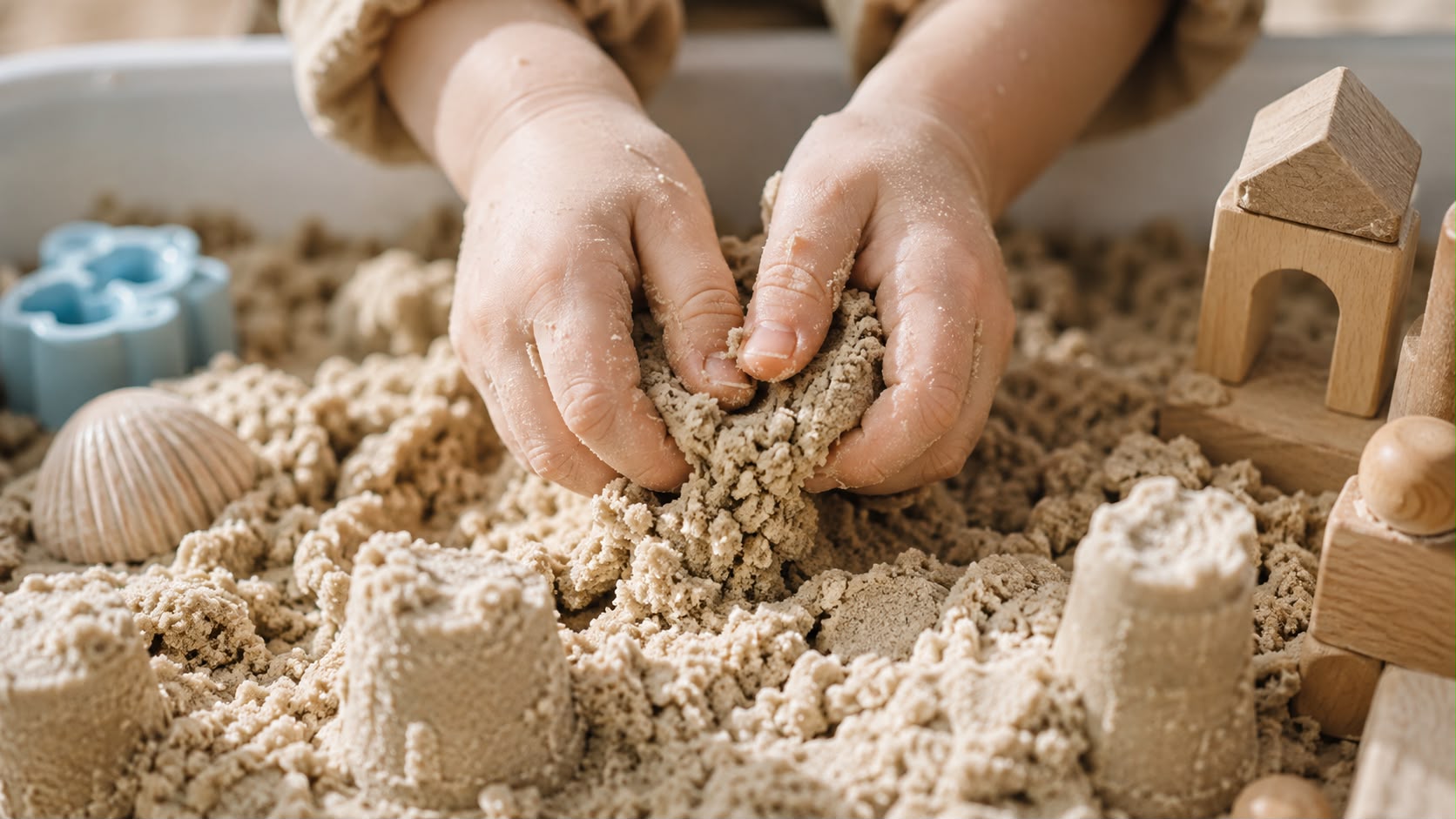
DIY kinetic sand – easy recipe with flour and oil
Magic sand has fascinated children for years. It feels soft, can be molded like damp sand, yet still flows loosely through your fingers. The best part: You can easily make magic sand yourself with just a few ingredients – no expensive craft kit needed, and in just a few minutes.
Whether for a rainy afternoon, creative playtime in the children's room, or as an activity for the holidays – homemade magic sand provides hours of fun and simultaneously promotes your child's imagination, fine motor skills, and sensory perception.
The short answer
Magic sand can be easily made from flour and vegetable oil. The basic recipe consists of about 8 cups of flour and 1 cup of oil. In just a few minutes, you'll have soft, moldable sand that's perfect for indoor play. In this guide, we'll show you various recipes, common mistakes, tips for shelf life, creative play ideas, and explain in an easy-to-understand way why magic sand works at all.
So you don't have to search long, this comprehensive guide provides everything parents truly want to know – from the classic recipe to colorful variations, and answers to frequently asked questions such as:
- Which flour is best?
- Why does magic sand sometimes become too dry or too sticky?
- How long does homemade magic sand last?
- Can you color it or decorate it with glitter?
- What age is magic sand suitable for?
💚 Tip for creative families
After crafting, the most beautiful part often begins: playing together, discovering, and creating memories. If you're looking for lovingly designed and personalized gifts for babies and children, you'll find handmade gift ideas at Schmatzepuffer for births, baptisms, school enrollment, and birthdays – many of which are individually personalized for your child and crafted with love in Germany.
Our tip: Personalized wooden toys and keepsakes are particularly lovely, often accompanying children for many years and retaining special meaning later on.
Unlike many short online instructions, we deliberately go a step further in this article. You'll receive not just a simple recipe, but a complete guide with background knowledge, different recipe variations, practical problem solutions, scientifically understandable explanations, and many creative ideas for children of different ages.
This way, you can choose the variation that best suits your family – and avoid typical mistakes right from the first attempt.
What exactly is magic sand?
Magic sand – also known as kinetic sand, moon sand, or magic sand – is a particularly moldable play sand that feels soft, can be easily compressed, yet still flows loosely through your fingers. This unusual property is precisely what makes it so fascinating for children.
Unlike regular sand, homemade magic sand doesn't dry out as quickly and can be reshaped again and again. Children can build castles, sculpt animals, create roads, or build small fantasy worlds. In the process, valuable sensory experiences are gained, playfully promoting development.
The term "magic sand" usually describes homemade versions made from flour and oil. Kinetic sand is often an industrially manufactured product with special binding agents. Both feel similar but differ in their composition and properties.
Why do children love magic sand?
Children discover their world with all their senses. Magic sand appeals to several senses simultaneously. It feels pleasantly soft, changes shape when kneaded, and invites continuous experimentation. This is why sensory toys are now commonplace in many families and kindergartens.
While adults often see only a simple craft project, children experience an exciting experiment. They observe how the sand flows, form small works of art, and then crush them again – without anything breaking. This free play particularly stimulates creativity and imagination.
Which skills are promoted through play?
Even a few minutes with magic sand can playfully support various developmental areas:
- Fine motor skills: Grasping, kneading, shaping, and pressing strengthen hand muscles.
- Sensory perception: Children learn to consciously perceive different materials and surfaces.
- Creativity: Simple shapes become castles, animals, roads, or fantasy worlds.
- Concentration: Many children engage with magic sand for surprisingly long periods.
- Language: Playing together offers many opportunities for telling stories, describing, and asking questions.
- Independence: Children decide for themselves what they want to build and try out.
💚 Schmatzepuffer Tip
The play experience becomes even more enjoyable with child-friendly cookie cutters, small wooden figures, or vehicles. After playing, the small works of art can be photographed and later viewed together – creating memories that are often just as valuable as the actual play.
If you're looking for high-quality and personalized gifts for little explorers, you'll find many lovingly designed gift ideas at Schmatzepuffer that encourage creativity and shared play.
Why does magic sand work at all?
Many parents wonder why simple flour and a little oil suddenly create a mass that feels almost like real kinetic sand. The explanation is surprisingly simple.
The oil forms a thin film around each individual flour grain. This causes the particles to lightly adhere to each other without fully sticking. If you press the sand together, it holds its shape. If you release it or move it between your fingers, the particles separate again, and the sand begins to flow loosely once more.
This interplay creates the typical play feeling that children love so much. Although magic sand is moldable, it remains loose and can be reshaped again and again – without water.
✔ The flour provides the fine texture.
✔ The oil loosely binds the individual particles together.
✔ When pressed, the sand holds its shape.
✔ When moved, it crumbles back into its loose consistency.
Making your own magic sand – the perfect basic recipe
First, the good news: You don't need special craft ingredients or expensive kits for homemade magic sand. You probably already have everything at home. With the right mixing ratio, you can create wonderfully soft, moldable play sand in just a few minutes, which often keeps children busy for hours.
Our recipe has been deliberately kept simple and can be easily adapted – depending on whether you want to make particularly loose, firmer, or colored magic sand.
🧺 Ingredients for a large portion of magic sand
| Ingredient | Quantity | Note |
|---|---|---|
| Wheat flour (Type 405) | 8 cups | Provides the fine texture. |
| Sunflower or rapeseed oil | 1 cup | Makes the sand supple and moldable. |
| Optional: Food coloring | As desired | For colorful magic sand. |
| Optional: Glitter | 1–2 tsp | For sparkling effects. |
Step-by-step instructions
-
Prepare the flour.
Put the flour into a sufficiently large bowl or tub. This allows everything to be mixed evenly later. -
Add oil slowly.
Don't pour in all the oil at once; add it gradually. This helps it distribute better and reduces clumps. -
Mix thoroughly.
First, mix everything with a spoon, then with your hands. After a few minutes, the mixture should feel soft, loose, and easily moldable. -
Check consistency.
Press some magic sand in your hand. If it holds its shape and then crumbles loosely again, the mixture is perfect. -
Refine as desired.
Now you can add glitter, coloring powder, or other decorative elements and mix well again.
💡 Pro Tip
Let the freshly made magic sand rest for about 10 to 15 minutes. During this time, the oil will distribute even more evenly in the flour. Afterwards, the sand usually feels even more pleasant and is easier to mold.
How to recognize perfect magic sand?
- ✔ It flows loosely through your fingers.
- ✔ It can be easily compressed.
- ✔ Small castles or figures briefly stand.
- ✔ It feels soft and supple.
- ✔ It doesn't stick to your hands.
If the consistency isn't right yet
| Problem | Solution |
|---|---|
| Too dry | Add a tablespoon of oil at a time. |
| Too oily | Gradually stir in some flour. |
| Too firm | Knead thoroughly again and add a few drops of oil if necessary. |
| Clumps heavily | Loosen with your hands or pass through a coarse kitchen sieve. |
💚 Creative Tip from Schmatzepuffer
Cut-out stars, hearts, or animals made of magic sand look especially beautiful if children then photograph them or integrate them into small fantasy worlds. For role-playing, wooden animals, small vehicles, or figures are also suitable, allowing new stories to emerge again and again.
Playing together is often the most beautiful family time – and precisely such moments remain in children's memories for a long time.
Which flour and which oil are best?
Generally, magic sand works with most types of flour. However, there are differences in consistency and feel. The choice of oil also influences the result. With the right combination, your magic sand will be particularly soft, moldable, and pleasant to handle.
Comparing the best types of flour
| Flour type | Rating | Properties |
|---|---|---|
| Wheat flour Type 405 | ⭐⭐⭐⭐⭐ | Very fine, particularly soft and ideal for beginners. |
| Spelt flour Type 630 | ⭐⭐⭐⭐☆ | Slightly coarser, also works very well. |
| Whole wheat flour | ⭐⭐⭐☆☆ | Rustic appearance, but less pliable. |
| Corn flour | ⭐⭐☆☆☆ | Only conditionally suitable, as the texture is coarser. |
Which oil should you use?
The oil ensures that the fine flour particles loosely connect. Neutral-tasting vegetable oils usually yield the best results.
| Oil | Recommendation | Special features |
|---|---|---|
| Sunflower oil | ⭐⭐⭐⭐⭐ | Our favorite – neutral, inexpensive, and readily available. |
| Rapeseed oil | ⭐⭐⭐⭐⭐ | Also excellently suited. |
| Coconut oil | ⭐⭐⭐☆☆ | Can solidify depending on room temperature. |
| Olive oil | ⭐⭐☆☆☆ | Works, but has a noticeably stronger smell. |
💡 Our practical tip
If children are helping with mixing, always add the oil in portions. This makes it easier to control the consistency and ensures the magic sand becomes particularly uniform.
Can you make magic sand colorful?
Yes! Colorful magic sand particularly excites children even more. However, it's important that the color is distributed as evenly as possible and that the sand's consistency is maintained.
Suitable options include:
- ✔ Powdered food coloring
- ✔ Gel food coloring (use sparingly)
- ✔ Cosmetic glitter or craft glitter
- ✔ Natural coloring powder, for example, from beetroot or turmeric
For a rainbow effect, you can color several small portions and then combine them in a large box. Children love to mix the colors again and again during play.
💚 Schmatzepuffer recommendation
Looking for a creative gift idea for little explorers? At Schmatzepuffer, you'll find lovingly personalized gifts for births, baptisms, school enrollment, and birthdays – many of which will accompany children for years and create lasting memories.
Our personalized wooden toys and keepsake gifts are particularly popular, and can be wonderfully combined with creative family afternoons.
How to store magic sand correctly?
To keep the magic sand soft and moldable for as long as possible, you should seal it airtight after playing. Food storage containers or well-sealed plastic boxes are ideal.
- ✔ Store in a cool, dry place.
- ✔ Protect from direct sunlight.
- ✔ Remove coarse dirt after each use.
- ✔ Do not leave it open permanently.
With clean storage, homemade magic sand usually lasts several weeks. However, since it is made from food ingredients, you should check it regularly and dispose of it as soon as its smell, color, or consistency changes significantly.
Is homemade magic sand safe for children?
Magic sand made from flour and oil is quick to make and offers many creative play possibilities. Nevertheless, it is not a food product, but a homemade play material. Therefore, children should only play with it under supervision and should not eat the sand or intentionally put it in their mouths.
Important: Magic sand made from flour is not intended for consumption
Even if the recipe only consists of flour and vegetable oil, the finished magic sand should not be called "edible". Flour is a raw natural product and is not heated in this recipe. In addition, dirt, saliva, pet hair or small foreign bodies can get into the mixture during play.
From what age is magic sand suitable?
A rigid age limit for homemade magic sand cannot be universally determined. The crucial factor is whether your child already understands that the material does not belong in their mouth, and whether they reliably play under supervision.
For babies and toddlers who still frequently explore objects and play materials with their mouths, the flour-oil mixture is not the best choice. For older children, magic sand can be a fun activity, provided an adult stays nearby and supervises the play situation.
| Situation | Our Assessment | What to look out for |
|---|---|---|
| The child frequently puts things in their mouth | Not yet suitable | It's better to use age-appropriate, tested play material. |
| The child understands simple game rules | Possible under close supervision | Play together and keep an eye on hands, face, and mouth. |
| The child plays independently and no longer puts material in their mouth | Well suited | Still stay nearby and check the material regularly. |
| Several children play together | Only with good supervision | Make sure nothing is thrown, eaten, or rubbed into eyes and hair. |
The most important safety rules at a glance
- Always supervise: Younger children, in particular, should not play with magic sand unsupervised.
- Do not eat: The mixture is a play material, not a snack or dough.
- Avoid eye contact: Flour dust and small particles can irritate the eyes.
- Do not intentionally inhale: Pour the flour slowly and avoid vigorous stirring.
- Wash hands: Hands should be thoroughly cleaned before and after playing.
- Use clean utensils: Bowl, molds, and storage container should be clean and dry.
- Consider allergies: In case of a known wheat, grain, or contact allergy, the material used should be checked beforehand or an alternative should be chosen.
- Keep pets away: Dogs, cats, and other pets should not lick or eat the magic sand.
Schmatzepuffer Tip for Relaxed Play
Pour the magic sand into a large, shallow plastic box or a wipeable play tub. A mat under the box will catch small crumbs. This keeps the play area tidy and makes it easier to collect the sand after playing.
What to consider for food allergies and intolerances?
Wheat flour is particularly practical for the classic recipe, but it is not suitable for every family. If there is a known allergy to wheat or other grains, the flour in question should not be used as play material. For sensitive skin, it may also be advisable to mix only a small amount initially and briefly test skin contact.
A different type of flour is not automatically allergen-free. Spelt, for example, also belongs to the wheat family. In the case of a diagnosed allergy, one should therefore not experiment independently, but choose a truly suitable alternative.
How to keep magic sand hygienic?
Since children knead the sand with their hands, place figures in it, and possibly cough or sneeze, homemade magic sand does not stay clean indefinitely. An airtight container protects it from moisture and dirt, but it does not make it indefinitely durable.
- Wash hands before playing. This way, less dirt and food residues get into the mixture.
- Use only clean and dry molds. Moisture can significantly shorten the shelf life.
- Check sand after playing. Foreign bodies, hair, and coarse dirt should be removed immediately.
- Store completely dry. If water gets into the magic sand, it should not simply be kept.
- Seal container tightly. A sturdy container protects against moisture and pantry pests.
When should you dispose of magic sand?
Don't rely solely on a general statement like "lasts several weeks." How long the mixture remains usable depends on how cleanly it was played with, how it is stored, and whether moisture has entered it.
Dispose of the magic sand as a precaution if:
- it smells unusual, rancid, or musty,
- its color visibly changes,
- moist spots or mold are visible,
- insects, larvae, or webbing are discovered,
- drinks, saliva, or other liquids have entered it,
- a child or pet has ingested large quantities,
- the sand is heavily soiled or has been left open for a long time.
It's better to make smaller portions
Instead of mixing a very large quantity right away, you can first try the recipe with four cups of flour and half a cup of oil. Smaller portions are used up faster, easier to store, and more hygienic to handle.
What to do if magic sand gets into the eyes?
If your child rubs magic sand into their eyes, they should try not to rub further. Carefully remove visible residue and gently rinse the affected eye with clean, lukewarm water. If pain, severe redness, or other discomfort persists, medical advice should be sought.
What to do if a child has tasted magic sand?
Stay calm, remove any residue from the mouth, and offer some water. In case of discomfort, a larger amount ingested, a known allergy, or uncertainty, medical advice or a poison control center should be contacted. The mixture should then not be used further.
The Short Answer
Homemade magic sand can be a wonderful play material for children who no longer put things in their mouths. It should always be used under supervision, not eaten, and stored cleanly and dry. For young children, allergies, or frequent mouth contact, a different, age-appropriate activity is the safer choice.
The 15 most common problems with magic sand – and how to solve them easily
Almost everyone knows it: the recipe is quickly mixed, but the result feels different than expected. Sometimes the magic sand is too dry, sometimes too sticky, or it can't be molded at all.
The good news: in most cases, the problem can be solved within a few minutes. Here you will find the most common mistakes – including the appropriate solution.
1. My magic sand is too dry
Cause: Flour absorbs oil at different rates. Temperature and humidity can also affect the result.
Solution: Add only one teaspoon of oil at a time and knead the sand thoroughly. Repeat the process slowly until the desired consistency is achieved.
2. The magic sand is too oily
Cause: A little too much oil was used or the oil had not yet fully distributed.
Solution: Gradually work in a little flour and then knead the mixture vigorously for several minutes.
3. The sand sticks to hands
Cause: The mixture usually contains a little too much oil.
Solution: Add a little more flour and mix thoroughly again.
4. The magic sand won't form
Cause: The mixture is often a bit too dry or has not been kneaded enough.
Solution: Add a few drops of oil and then work the sand intensively for at least two to three minutes.
5. There are many lumps
Cause: The oil was added too quickly.
Solution: Crush lumps with your hands or pass the sand through a coarse kitchen sieve.
6. The magic sand is very dusty
Cause: The mixture contains too little oil.
Solution: Add a few drops of oil and mix thoroughly.
7. The sand smells unpleasant
Cause: The oil used has gone old or the mixture has been stored for too long.
Solution: For hygienic reasons, you should dispose of the magic sand and make a fresh batch.
8. The sand changes color
Cause: Moisture or unsuitable dyes can alter the mixture.
Solution: Only use dry dyes and always store the sand dry.
9. Hands get colored
Cause: Too much food coloring was used.
Solution: Use less color or mix powdered colors particularly thoroughly.
10. The magic sand hardens after a few days
Cause: It was not stored airtight.
Solution: Immediately after playing, transfer it to a tightly sealed container.
💚 Family Tip from Schmatzepuffer
A large play tub with a lid is perfect for storing magic sand. This keeps the material clean and can be used again immediately on the next rainy day. With a few molds, small wooden figures, or toy animals, a creative world of experience can be created in no time.
It is precisely these shared crafting and play moments that children often remember longer than any finished toy.
11. The magic sand molds
Cause: Water or moisture has entered the mixture.
Solution: Moldy magic sand should always be completely disposed of.
12. The sand feels too firm
Cause: Too much flour or too little oil.
Solution: Add a few drops of oil and knead thoroughly.
13. The sand crumbles immediately
Cause: The oil had not yet fully distributed itself.
Solution: Let the mixture rest for about ten minutes and then knead again.
14. The magic sand leaves a lot of crumbs
Cause: This is basically normal. Homemade magic sand behaves a little differently than industrially produced kinetic sand.
Solution: Play on a large mat or in a shallow plastic box if possible.
15. My magic sand looks completely different from the photos
Cause: Depending on the type of flour, oil, room temperature, and mixing ratio, the result may vary slightly.
Solution: This is completely normal. Small adjustments to the mixing ratio usually lead quickly to the desired consistency.
Remember this
Almost all problems with magic sand arise from a slightly unbalanced mixing ratio. Therefore, always work in small steps: it's better to add a little flour or oil gradually than to add large amounts all at once. This way, you'll achieve the perfect consistency much faster.
7 Magic Sand Recipes Compared – Which Version is Best for Your Family?
The classic recipe of flour and vegetable oil is not the only way to make magic sand. Depending on what ingredients you have at home or what play experience you want to achieve, there are different variations.
Here we show you the most popular recipes – with their respective advantages and disadvantages.
If you are making magic sand for the first time, start with the classic recipe using flour and sunflower oil. It's inexpensive, quick to make, and usually works reliably.
1. The classic recipe with flour and oil ⭐ Our recommendation
| Advantages | Disadvantages |
|---|---|
| ✔ Quick to make ✔ Inexpensive ingredients ✔ Soft play feel ✔ Ideal for beginners |
✖ Not waterproof ✖ Not suitable for consumption |
2. Magic sand with fine play sand
If you want a play experience closer to real sand, you can replace part of the flour with very fine, clean play sand. This makes the mixture grittier and particularly suitable for building castles or small construction sites.
Suitable for: Children who enjoy playing with molds or vehicles.
3. Colorful Magic Sand
Powdered food coloring or special craft paints create vibrant colors. A mixture of several small portions in different shades looks especially beautiful.
Ideal for: Rainbow worlds, princess castles, or imaginative underwater landscapes.
💚 Creative Play – Creating Memories
After crafting, often the best part begins: building together, exploring, and inventing stories. These are precisely the moments that children remember for a long time.
If you're looking for a special gift idea, you'll find lovingly personalized gifts for birth, christening, school enrollment, and birthdays at Schmatzepuffer. Many products are custom-made and accompany children for many years.
Tip: Photograph your child's little constructions. Over time, this creates a very personal memory album full of creative family moments.
4. Glitter Magic Sand
A small amount of fine craft glitter gives the magic sand a sparkling effect. This variant is particularly popular for themed worlds such as unicorns, fairies, mermaids, or starry skies.
Our tip: Less is more. Even half a teaspoon of glitter is often enough.
5. Scented Magic Sand
Some families add a few drops of a suitable fragrance oil. This gives the sand a pleasant smell.
Note: Fragrances can irritate sensitive children. Therefore, use them very sparingly or refrain from using them altogether if your child is sensitive to scents.
6. Magic Sand with Cornstarch
Various recipes using cornstarch can be found online. They can work, but their consistency differs significantly from the classic flour-oil recipe. The result often feels finer and less gritty.
If you want to try this variation, first make only a small amount and test whether you like it.
7. Seasonal Magic Sand Ideas
With a few decorative elements, magic sand can be adapted to any season:
- 🌸 Spring – Flowers, butterflies, and small wooden animals
- ☀ Summer – Shells, boats, and sandcastles
- 🍂 Autumn – Chestnuts, leaves, and forest animals
- ❄ Winter – Snowflakes, stars, and small fir trees
- 🎄 Christmas – Stars, angels, and winter molds
- 🐣 Easter – Eggs, bunnies, and chicks
Our Conclusion on Recipe Variations
For most families, the classic recipe of flour and vegetable oil is the best choice. It consistently works, costs little, and provides a pleasant play experience. Colors, glitter, or seasonal decorations then add variety to the play without having to change the basic recipe.
50 Creative Play Ideas with Magic Sand – for Children of All Ages
Once the magic sand is ready, the real fun begins. Children often don't need elaborate toys for this. A few molds, small figures, or natural materials are enough to constantly create new play worlds.
The following ideas not only promote creativity but also fine motor skills, concentration, language, and imagination.
💡 Tip for Parents
You don't have to try all the ideas at once. Often, just a small change – for example, different figures or new molds – makes the magic sand feel like a completely new game for children.
For Children aged approx. 2 to 3 years
At this age, the focus is on feeling, pressing, and discovering.
- Leaving tracks with their hands.
- Building small hills and flattening them again.
- Burying and unearthing animal figures.
- Using large cookie cutters.
- Filling cups and pouring them out again.
- Hiding and finding stones or shells.
- Comparing fingerprints.
- Working with small shovels.
- Building first simple shapes.
- Driving cars or tractors through the sand.
For Children aged approx. 4 to 5 years
Now, entire fantasy worlds often emerge.
- Building a dinosaur landscape.
- Designing a farm.
- Setting up a construction site with excavators.
- Designing a treasure island.
- Building a princess castle.
- Creating a mermaid world.
- Setting up a zoo with animals.
- Building roads and bridges.
- Selling cakes and ice cream.
- Playing restaurant.
- Creating a space landscape.
- Hiding pirate treasure.
- Modeling a volcano.
- Forming river courses and lakes.
- Building small villages.
💚 Playing Together – Creating Memories Together
Children rarely remember later which toy was the most expensive. They remember with whom they played.
A shared crafting or play afternoon with magic sand, a few figures, and a lot of imagination often creates memories that last a long time.
At Schmatzepuffer, you'll find lovingly personalized gifts that accompany such family moments – from keepsakes for birth to high-quality gifts for christening, birthday, or school enrollment.
For Children aged approx. 6 years and up
As children get older, the constructions become larger and the play ideas more sophisticated.
- Writing letters.
- Arranging numbers.
- Representing first math problems.
- Building mazes.
- Planning marble runs.
- Designing landscapes with mountains.
- Playing archaeologist and excavating fossils.
- Building a knight's castle.
- Re-enacting a knight's battle.
- Designing a castle with a moat (without water in the sand).
- Planning cities.
- Creating a safari landscape.
- Building a football stadium.
- Designing a moon landscape.
- Developing their own fantasy story.
Play Ideas for Multiple Children
- Who builds the tallest tower?
- Who finds the hidden treasure first?
- Building an entire city together.
- Designing an animal world.
- Opening a restaurant.
- Building a dino exhibition.
- Construction site competition.
- Which animal leaves which track?
- Creating a fairytale world together.
- Recreating a favorite vacation spot with magic sand.
Play Ideas for Learning
- Tracing letters.
- Writing their own name.
- Recognizing shapes.
- Sorting colors.
- Learning numbers.
- Comparing sizes.
- Creating patterns.
- Telling stories.
- Hiding and describing objects.
- Writing first words.
Our Favorite Game
Each family member builds a small landscape out of magic sand. Afterwards, everyone tells a story together in which each landscape appears. This often leads to the funniest ideas – and incidentally, imagination, language, and creativity are playfully encouraged.
Why Magic Sand is More Than Just a Craft Project
At first glance, magic sand is simply a creative activity for children. In reality, there is much more to it. While kneading, shaping, and building, numerous skills important for children's development are trained incidentally.
The best part: children learn playfully. They feel like they are just having fun – and that's precisely why what they learn often sticks particularly well in their memory.
The Short Answer
Playing with magic sand promotes fine motor skills, hand-eye coordination, creativity, concentration, and sensory perception, among other things. At the same time, free play provides space for imagination, language, and shared discovery.
1. Strengthening Fine Motor Skills
When kneading, pressing, shoveling, and shaping, both hands constantly work together. Children thus train their finger and hand muscles. These movements are later helpful for painting, writing, crafting, or buttoning, among other things.
2. Promoting Sensory Perception
Magic sand feels soft, loose, and yet moldable. Children experience different pressure strengths, surfaces, and movements. Such sensory experiences are among the foundations of healthy development and bring many children particular joy.
3. Developing Creativity and Imagination
Today a dinosaur island is created, tomorrow a knight's castle, and the day after tomorrow perhaps an underwater world. There is no right or wrong. Precisely this free play fosters imagination and encourages children to implement their own ideas.
4. Training Concentration
Many parents observe that their children are engaged with magic sand for an astonishingly long time. The calm shaping, building, and creating help many children to focus on a task for an extended period.
5. Playfully Promoting Language
When playing together, conversations naturally arise. Children tell stories, describe their constructions, or explain their ideas. This expands their vocabulary and helps them practice putting thoughts into words.
6. Learning to Play Together
When several children play together, they have to coordinate, share materials, and find solutions together. This promotes social competencies such as consideration, communication, and teamwork.
💚 Family Time Instead of Screen Time
Even half an hour of shared play can become a special family moment. Laughing, building, and inventing stories together creates memories that often last longer than the latest TV show or a computer game.
At Schmatzepuffer, we believe that personal experiences and shared time are the most beautiful gifts. That's why we develop lovingly personalized products that accompany families – from birth to christening, birthday, and school enrollment.
7. Gathering First Mathematical Experiences
Numbers and shapes can also be playfully discovered with magic sand. Children can form circles, squares, or triangles, compare quantities, or lay out first math problems. This happens incidentally and without performance pressure.
8. Strengthening Self-Confidence
Every completed castle, every road, or every small figure is a sense of achievement. Children experience that they can create something with their own hands. This feeling strengthens self-confidence and motivates them to try out new ideas.
Our Conclusion
Magic sand is far more than a simple craft idea. It combines creative play with valuable learning experiences and at the same time creates time for shared family experiences. That's why it has been one of the most popular DIY ideas for children for years.
Frequently Asked Questions About Magic Sand (FAQ)
Here you will find answers to the questions parents most frequently ask about homemade magic sand. Perhaps your exact question is already among them.
The Short Answer
Homemade magic sand is easy to make, can be varied with a few ingredients, and offers children many creative play opportunities. With proper storage, it usually remains usable for a certain period. Hygienic storage and playing under supervision are important.
How long does homemade magic sand last?
There is no fixed time. What is crucial is how cleanly the magic sand is used and stored. If it is stored dry, clean, and airtight, it often remains usable for a longer period. If the smell, color, or consistency changes significantly, you should dispose of it.
Can you soften magic sand again?
Yes. If the sand feels a bit dry, a very small amount of vegetable oil is usually enough. Add the oil drop by drop and knead the sand thoroughly.
Can you freeze magic sand?
We advise against it. Freezing often significantly changes the consistency. Furthermore, moisture can form during thawing, which reduces shelf life.
Can you use magic sand outdoors?
Yes, on a clean surface or in a play tub, magic sand is also fun in the garden or on the terrace. However, avoid damp surfaces and direct contact with soil or sand, as this changes the mixture.
What happens if magic sand gets wet?
If water gets into the magic sand, it loses its typical consistency. Small damp spots can sometimes be removed. If the entire mixture has become wet, it is usually advisable to make new magic sand.
Can I vacuum magic sand?
Small amounts can usually be vacuumed without problems. However, larger amounts or oily residues can strain vacuum cleaners and filters. Therefore, it is better to first pick up the sand by hand or with a small broom.
How do I get magic sand out of carpets?
First, let the sand dry completely and carefully remove larger residues by hand. Then the carpet can be vacuumed. Do not rub damp spots into the carpet.
💚 Schmatzepuffer Tip
A large play mat or a washable underlay makes cleaning up significantly easier. After playing, the magic sand can simply be put back into the storage box – and the floor stays clean.
This leaves more time for the essentials: playing together and beautiful family moments.
Can I color magic sand with food coloring?
Yes. Powdered dyes or gel colors are particularly suitable. Liquid colors should only be used very sparingly so that the consistency does not suffer.
Which molds are best?
Sturdy cookie cutters, sand molds, small cups, or silicone molds are ideal. Building blocks, wooden animals, or toy vehicles also provide varied play worlds.
Can you give magic sand as a gift?
Homemade magic sand makes a good small gift if it is hygienically packaged and labeled as a play material. However, it is not a suitable gift idea for children who still put many things in their mouths.
Is magic sand sustainable?
Since many ingredients are already available in the kitchen, magic sand can be made without elaborate packaging. At the same time, no single-use packaging from craft kits is created. Nevertheless, the mixture should be disposed of responsibly after use and not released into nature.
Can I mix several colors?
Of course. Many children particularly enjoy combining different colors. Over time, this creates completely new shades and exciting patterns.
Why do children like magic sand so much?
Magic sand feels different from ordinary sand. It can be shaped, yet flows loosely through the fingers, and encourages free play. It is precisely this combination that makes it so fascinating for many children.
What goes well with an afternoon of playing with magic sand?
In addition to molds and figures, small vehicles, wooden animals, or natural materials like stones and shells provide ever-new play ideas. This creates creative theme worlds with little effort that often keep children occupied for a long time.
Our Conclusion
With the right recipe, a little creativity, and proper storage, homemade magic sand becomes a versatile activity for the whole family. Many questions can be quickly resolved with small adjustments to the mixing ratio or storage – and nothing stands in the way of the next creative play afternoon.
Conclusion: Making magic sand is fun – and creates valuable family moments
Making magic sand yourself is easy, inexpensive, and done in a few minutes. With just a few ingredients, you create a creative play material that often keeps children engaged for a long time and repeatedly excites them.
But the real value is not just in the finished magic sand. Much more important are the shared moments of mixing, experimenting, building, and telling stories. It is precisely these small experiences that often remain in children's memories longer than a new toy.
Whether castles, dinosaur worlds, farms, or fantasy landscapes – there are hardly any limits to creativity. At the same time, children playfully develop their fine motor skills, imagination, and concentration.
✔ The Most Important at a Glance
- ✔ Magic sand can be made yourself with a few ingredients.
- ✔ The classic recipe with flour and vegetable oil works reliably for most families.
- ✔ With colors, glitter, or seasonal decorations, new play worlds are constantly created.
- ✔ Clean storage and playing under supervision ensure greater safety.
- ✔ Magic sand promotes creativity, imagination, and fine motor skills.
- ✔ Small changes always ensure new fun.
Our Checklist for the Perfect Magic Sand Afternoon
| Done? | Checkpoint |
|---|---|
| ☐ | Ingredients prepared. |
| ☐ | Large bowl or play tub ready. |
| ☐ | Molds and shovels ready. |
| ☐ | Underlay for easier cleanup. |
| ☐ | Airtight container for storage ready. |
| ☐ | Take time and get creative together. |
💚 Even more ideas for little explorers
If your child loves to play creatively, discover, and create with their hands, you'll find many lovingly selected products for little adventurers at Schmatzepuffer.
- 🌿 Personalized gifts for birth
- ✝️ Individual baptism gifts with names
- 🎂 Special birthday gifts for children
- 🎒 Gift ideas for kindergarten and school enrollment
- 🧸 High-quality wooden toys and personalized keepsakes
Our products are designed with much love and are meant not only to accompany families in everyday life but also to bring joy for many years.
Did this guide help you?
Then save it for later or share it with friends and family. Perhaps the recipe will also help other parents to spend a creative afternoon with their children.
We wish you and your family much joy in trying it out – and above all, many beautiful shared memories.
10 Misconceptions About Magic Sand – What's Really True?
Many tips and claims circulate about homemade magic sand. Some of them actually work, while others tend to lead to disappointment. We have categorized the most common statements for you.
The short answer
Not every tip from the internet leads to a good result. The right consistency mainly depends on the mixing ratio, the ingredients used, and clean storage.
Misconception 1: The more oil, the better the magic sand.
False. Too much oil makes the mixture greasy and difficult to shape. Always add oil in small amounts and knead the sand thoroughly in between.
Misconception 2: Every type of flour yields the same result.
Not quite. Fine wheat flour usually provides the smoothest consistency. Other types of flour can also work, but sometimes feel significantly different.
Misconception 3: Magic sand lasts indefinitely.
No. Since the basic recipe consists of kitchen ingredients, the mixture should be checked regularly. If the smell, color, or consistency changes, it should be disposed of.
Misconception 4: Children need expensive accessories.
No. Often, simple cookie cutters, cups, spoons, small vehicles, or wooden animals are enough. Children primarily use their imagination.
Misconception 5: More glitter makes the sand more beautiful.
Not necessarily. Even a small amount creates a nice effect. Too much glitter often changes the play feel.
💚 Our tip for creative families
The most beautiful accessories often cost nothing at all. Shells from the last holiday, chestnuts from autumn, small stones, or pine cones transform magic sand into a new world of experience in no time.
At Schmatzepuffer, we believe that imagination is more important than having lots of toys. Our personalized gifts are meant to inspire children to play, discover, and remember – not just for a day, but for many years.
Misconception 6: Magic sand is only for young children.
No. Older children also enjoy using magic sand for landscapes, constructions, role-playing, or creative projects.
Misconception 7: Magic sand is only for rainy days.
No. On a dry terrace or in the garden, magic sand can provide just as much fun – as long as it stays clean and dry.
Misconception 8: The sand is used up after one play session.
False. If the magic sand is used cleanly and stored correctly, it can be reused multiple times.
Misconception 9: Only perfect castles are fun.
Quite the opposite. For children, it's usually not the result that matters, but the process. Trying things out, knocking them down, and rebuilding are just as much a part of it as the finished construction.
Misconception 10: Magic sand is just a craft idea.
No. Magic sand combines creative play, sensory experiences, and shared moments. That's why it has delighted families for many years and is one of the most popular DIY ideas for children.
Our conclusion on the myths
The best recipe is of little use if the fun is lost. Children don't need a perfect sandcastle – they need time, imagination, and people to play with. That's where the most beautiful memories are made.
Magic sand at a children's birthday party – a play idea that almost always delights
Anyone who has ever organized a children's birthday party knows the challenge: children want to be entertained, at the same time as little chaos as possible should arise, and everyone should have fun together.
This is where magic sand can be a wonderful idea. With a large play tub, some molds, and small figures, a creative play station is created within minutes, where children are often engaged for a surprisingly long time.
The short answer
A magic sand station is excellent for children's birthday parties. It requires little preparation, can be adapted to different age groups, and promotes creative cooperative play instead of pure screen entertainment.
How to set up a magic sand play station
You don't need much for it. Usually, these are enough:
- ✔ a large plastic tub or a flat play table
- ✔ homemade magic sand
- ✔ sand molds
- ✔ small shovels and cups
- ✔ wooden animals or play figures
- ✔ small excavators or tractors
- ✔ natural materials like stones, shells, or pine cones
With just these few things, dinosaur worlds, farms, castles, or entire fantasy cities can be created.
7 Play Ideas for a Children's Birthday Party
- Treasure hunt: Hide and find small treasures in the magic sand.
- Who builds the highest castle? Together or in small teams.
- Dig up dinosaurs: Hide and excavate small dinosaur figures.
- Build an animal world: Each child designs their own farm or zoo.
- Princess's castle: Form towers, walls, and paths.
- Construction site: Build roads and houses with excavators.
- Community project: All children build a large fantasy world together.
💚 Our tip for a special birthday gift
When a children's birthday is coming up, many parents, grandparents, or godparents look for a personal gift idea. Gifts that are not forgotten after a few days but accompany children for many years are especially nice.
At Schmatzepuffer, you'll find lovingly personalized birthday gifts – from high-quality wooden toys to individual keepsakes with names. This turns a gift into something very personal.
Extra tip: Many of our products are also excellent as a shared gift from several guests.
Party favors with a difference
It doesn't always have to be sweets or small plastic toys. If you like, you can give each child a small tin with homemade magic sand to take home. Supplemented with a small recipe card, it becomes a personal party favor that children can later recreate with their parents.
Why parents love this play idea so much
Many classic birthday games only last a few minutes. Afterward, the question often arises: "What do we do now?"
A magic sand station works differently. Children decide for themselves what they want to build, switch between ideas, and often stay engaged for significantly longer than expected. At the same time, conversations, shared play, and many creative ideas emerge.
Our Conclusion
Whether it's a children's birthday, family celebration, holiday, or a rainy afternoon – magic sand is much more than a simple craft project. It brings children together, stimulates their imagination, and creates shared experiences that many families will remember for a long time.
Magic sand as an activity for rain, holidays, or weekends
Everyone knows this situation: it's raining outside, the playground is out of the question, and after a short time the question comes up: "What can we do now?" Magic sand is perfect for such days. It can be prepared quickly, requires little space, and keeps many children occupied for a long time.
What's particularly nice is that children constantly develop new ideas. Today a knight's castle is created, tomorrow a dinosaur world, and next weekend perhaps a small construction site. This way, a simple play material always becomes a new adventure.
The short answer
Magic sand is ideal for rainy days, holidays, weekends, or quiet afternoons at home. With a few molds, figures, or natural materials, new play ideas are constantly created, without the need to constantly buy new toys.
A simple play afternoon in four steps
-
Prepare play area.
Lay out a wipeable mat or a large play tub. This keeps the magic sand in one place and makes tidying up much quicker later. -
Select material.
Supplement the magic sand with some molds, small wooden figures, vehicles, or natural materials like shells, stones, or pine cones. -
Choose a theme.
For example, a farm, underwater world, jungle, construction site, dinosaurs, or fairy tale forest. Even a small motto often sparks new ideas. -
Play together.
Let your child decide as freely as possible what they want to build. Often, the most exciting stories emerge without fixed rules.
Ideas for every season
| Season | Play Idea |
|---|---|
| 🌸 Spring | Create flower meadows, butterflies, and small gardens. |
| ☀ Summer | Build beach landscapes, sandcastles, or treasure islands. |
| 🍂 Autumn | Design a forest with chestnuts, leaves, and forest animals. |
| ❄ Winter | Recreate a winter village, fir forest, or Christmas market. |
💚 Schmatzepuffer-Tip for creative families
Children love it when their play world grows over time. Gradually add small wooden animals, vehicles, or figures to the magic sand. This creates new stories without constantly having to buy completely new play material.
If you're also looking for a special gift, you'll find many personalized gift ideas for birth, baptism, birthdays, or school enrollment at Schmatzepuffer. Many products are individually designed with names and accompany children for many years.
Our favorite thought: Creative family time is often the most valuable gift – and personal keepsakes make these moments even more special.
Why free play is so valuable
Not every activity needs fixed rules or a concrete goal. In free play, children decide for themselves what they want to build, change, or tear down again. This is precisely where creativity, problem-solving skills, and often the most beautiful shared conversations arise.
Sometimes just one screen-free hour, filled with imagination and quality time together, is enough to transform an ordinary afternoon into a beautiful family memory.
15 Practical Tips That Make All the Difference
After many attempts, it's clear: often, it's the small things that make a play afternoon more relaxed. With the following tips, you'll save time on preparation, have less effort cleaning up, and ensure that the kinetic sand provides joy for as long as possible.
The Short Answer
A large play tub, a few selected play materials, and enough time are often more important than lots of molds or decorations. Children primarily need space for their own imagination.
1. Less is Often More
Too many molds or figures can quickly overwhelm children. Start with fewer materials and add more play ideas as needed.
2. Large Tubs Instead of Small Bowls
The larger the play area, the easier it is for children to build and create. At the same time, the kinetic sand stays in one place better.
3. Incorporate Favorite Toys
Many children already have small vehicles, animal figures, or action figures at home. These can be wonderfully integrated into the kinetic sand world.
4. Invent a Story
Instead of just building castles, you can create a story together. Who lives there? What happens next? This often leads to completely new play ideas.
5. Take Photos of the Creations
Children are often proud of their works. A photo captures these memories – even if the structure is taken down later.
💚 Memories Instead of Disposable Toys
The most beautiful family moments often arise not from constantly new toys, but from shared time. A photo of a built castle, an afternoon spent together, or a personalized gift with their name often accompanies children longer than a short-lived trend.
That's why at Schmatzepuffer, we create personalized gifts that accompany families for many years – from birth to baptism, birthdays, and school enrollment.
Our Wish: Less consumption, more shared memories.
6. Let the Child Decide
It doesn't have to be a perfect castle. Children often develop the most creative ideas when adults don't dictate every little detail.
7. Take Short Breaks
Especially younger children benefit from taking a drink or moving around for a short while in between. Afterward, they often resume playing with renewed enthusiasm.
8. Collect Natural Materials
Stones, shells, pinecones, or small branches make any play world more varied – and cost nothing.
9. Create Themed Weeks
One week dinosaurs, the next a farm, then an underwater world – this makes the same kinetic sand feel new every time.
10. Clean Up Together
Even collecting the kinetic sand can be turned into a game. Many children enjoy helping if it becomes a small game.
11. Don't Strive for Perfection
Crooked castles and winding roads are part of it. The focus is on the joy of creating together.
12. Praise Creativity Instead of Evaluating Results
Questions like "How did you come up with that idea?" often encourage conversation more than a simple "That's nice."
13. Brainstorm New Challenges Together
Who will build a bridge? Who will design a zoo? Small tasks always bring fresh momentum to the game.
14. Regularly Check the Kinetic Sand
Before each play session, briefly check the smell, consistency, and cleanliness. This keeps the play material hygienic and pleasant.
15. Enjoy the Moment
Not every game has to serve an educational purpose. Sometimes it's enough to laugh together, build, and simply spend time with each other.
Our Practical Conclusion
Children rarely remember later how perfect a sandcastle looked. They remember that mom, dad, grandma, or grandpa helped build it. It's precisely these shared experiences that turn a simple afternoon into a valuable memory.
Why Children Find Kinetic Sand So Fascinating
Many parents experience the same thing: while other toys are put aside after a few minutes, children often engage with kinetic sand for surprisingly long periods. But why is that?
The answer is simpler than many assume. Kinetic sand offers children something that is becoming increasingly rare in everyday life: free play without fixed rules.
There is no right or wrong. No points, no winners, and no losers. Children decide for themselves what should emerge – and that's precisely what makes it so appealing.
The Short Answer
Kinetic sand combines various sensory impressions with creative play. Children can feel, shape, build, change, and immediately start anew. It is precisely this freedom that makes playing particularly exciting for many children.
Learning with Their Hands
Children don't just discover their environment with their eyes. They grasp, press, knead, pour, and compare different materials. Kinetic sand constantly changes its form. It is precisely this immediate experience that makes it so interesting.
When compressed, the sand briefly holds its shape, then disintegrates again. For children, this is always a small experiment that sparks their curiosity.
Every Structure is Just the Beginning
Adults often think in terms of results: once the castle is finished, the goal is achieved.
Children often see this very differently. For them, the actual play often only begins afterward. The castle is expanded, torn down again, rebuilt, or transformed into a completely different landscape.
This constant change ensures that boredom does not arise.
Imagination Needs No Instructions
A spoon can suddenly be an excavator. A stone becomes a treasure. A small wooden figure transforms into a knight or a princess.
Materials like kinetic sand, in particular, leave plenty of room for one's own ideas. Children decide for themselves what story they want to tell.
💚 Family Time That Lasts
Sometimes elaborate outings are not necessary. An afternoon together at the kitchen table, some kinetic sand, and plenty of imagination are often enough to create valuable memories.
At Schmatzepuffer, we believe that precisely these small moments make everyday family life special. That's why we create personalized gifts that accompany children for many years and remind them of special moments.
Our Thought: The most beautiful gift is often shared time.
Why Repetition is Good for Children
Many adults wonder why children build the same castle again and again or hide the same treasure repeatedly.
For children, however, repetition is not a sign of boredom. They try out new ideas, change small details, and gain experience in the process. This is precisely how new play ideas often develop.
Peace in a Hectic Everyday Life
Family life offers many impressions: school, kindergarten, appointments, and media. A quiet game with kinetic sand provides a pleasant balance for many children.
Without time pressure, they can concentrate on a task, create, and let their imagination run wild.
Playing Together Connects
Kinetic sand is excellent for playing together. Parents, siblings, grandparents, or friends can build along, invent stories, or solve small tasks.
This leads to conversations, shared laughter, and often memories that extend far beyond the actual play afternoon.
Our Conclusion
Kinetic sand fascinates children not because it is particularly elaborate. It fascinates because it creates free space. From a simple material, new ideas, stories, and small adventures emerge every day – and that's precisely what makes it one of the most popular creative activities for families.
Removing Kinetic Sand – How to Quickly Clean Floors, Carpets, and Clothes
No matter how carefully children play – a few crumbs almost always end up next to the play tub. This is completely normal. However, with the right steps, kinetic sand can usually be removed quickly and easily.
The Short Answer
Keep spilled kinetic sand as dry as possible, first pick up larger quantities by hand, and then carefully clean the rest. This prevents the mixture from smearing unnecessarily.
Removing Kinetic Sand from Tiles or Laminate
Cleaning is particularly easy on smooth floors. First, pick up larger quantities by hand or with a small hand brush. The remaining crumbs can then be vacuumed up. If a slight oil film remains, a damp cloth with a little mild detergent is usually sufficient.
Removing Kinetic Sand from Carpets
On carpets, a little patience is required. Keep the sand as dry as possible and carefully remove larger quantities by hand. Then, any remaining crumbs can be vacuumed up. Do not rub the mixture into the carpet with a wet cloth, as this can spread residues deeper into the fibers.
Removing Kinetic Sand from Clothing
First, thoroughly shake the clothing outdoors. If any residue remains, carefully remove it by hand or with a soft brush. Afterward, the garment can be washed as usual according to the care instructions.
How to Best Protect the Play Area?
With good preparation, cleanup is often limited to just a few minutes.
- ✔ Use a large plastic tub.
- ✔ Lay out a wipeable mat or tablecloth.
- ✔ Have children play while sitting, if possible.
- ✔ Only provide the necessary amount of kinetic sand.
- ✔ Seal the sand immediately after playing.
💚 Schmatzepuffer Tip for Relaxed Family Afternoons
A well-prepared play area not only saves time during cleanup but also ensures more joy during play. A large box, a few favorite figures, and a soft mat are often completely sufficient.
Anyone who regularly spends creative afternoons with children knows: it doesn't always have to be new toys. Much more important are shared experiences and materials that repeatedly enable new ideas.
That's why at Schmatzepuffer, you'll find durable, personalized gift ideas that accompany children for many years and constantly invite them to play and discover together.
5 Simple Rules for Less Mess
- Before playing, remove jewelry and roll up or push up long sleeves if possible.
- Use only a manageable amount of kinetic sand at a time.
- Do not place drinks and open food directly next to the play tub.
- Clean up together after playing – this often goes faster than expected.
- Store the kinetic sand afterward in a clean, tightly sealed container.
Our Conclusion
A little kinetic sand next to the play tub is almost always part of it. However, with good preparation and a few simple steps, the cleanup effort remains manageable – and the shared time with the children remains the focus.
What Accessories Make Kinetic Sand Even More Exciting?
Imaginative play doesn't require a large selection of toys. Often, a few well-chosen materials are enough for children to constantly create new worlds. With the right accessories, kinetic sand remains interesting for many months, even though the basic material itself doesn't change.
The Short Answer
A large play tub, some molds, small figures, and natural materials are usually completely sufficient. Children don't need a large selection – they need materials that stimulate their imagination.
Our Recommendation for Basic Equipment
| Accessory | Why It Makes Sense |
|---|---|
| Large Plastic Tub | Keeps the sand in one place and makes cleanup easier. |
| Sand Molds | Ideal for castles, animals, or fantasy figures. |
| Small Shovels and Cups | Perfect for pouring, filling, and experimenting. |
| Wooden Animals or Figurines | Transform a sand area into a lively play world. |
| Natural Materials | Stones, shells, or pinecones always bring new ideas into play. |
Constantly Redesigning Play Worlds
The biggest advantage of kinetic sand: with a few changes, a new adventure is created every time.
- 🦕 Dinosaur park with small dinosaur figures
- 🚜 Construction site with excavators and trucks
- 🐄 Farm with animals and fences
- 🏰 Knight's castle with walls and towers
- 🧜 Underwater world with shells and sea creatures
- 🚀 Moonscape with astronauts and rockets
- 🌲 Forest with animals, pinecones, and small branches
How to Keep Accessories Organized
It's best to store molds, figures, and tools together with the kinetic sand in a larger box. This way, everything is immediately at hand for the next play session, and nothing gets lost.
💚 Schmatzepuffer Tip
Play materials made of wood are particularly durable. They feel pleasant to the touch, can be used in many ways, and accompany many children for years. That's why we consciously focus on high-quality materials and timeless designs for many of our products.
Whether personalized wooden gifts for birth, special baptism gifts, or gift ideas for birthdays – our goal is to create products that not only look beautiful but also constantly invite shared play, discovery, and memory.
Less is Often More
Many parents want to offer as many accessories as possible. In practice, however, the opposite often proves true: with a small selection, children often engage more intensely and develop more creative ideas. Too many materials, on the other hand, can quickly distract.
Our Conclusion
Kinetic sand doesn't need a lot of equipment. A few selected materials, some imagination, and shared time are completely sufficient for new play worlds to emerge again and again. That's precisely what makes this creative activity so special.
The most common mistakes the first time – and how your magic sand turns out perfectly right away
Almost everyone who makes magic sand for the first time makes small mistakes. This is completely normal. Even small differences in ingredients or mixing can change the result.
To ensure your first attempt is as successful as possible, we have compiled the most common pitfalls.
The short answer
The biggest mistake is usually working too fast. If you add oil slowly, knead thoroughly and check the consistency in between, you will almost always get a pleasantly malleable magic sand.
❌ Mistake 1: Pouring in all the oil at once
Many people pour the entire amount of oil into the flour at once. This quickly creates oily spots and lumps.
Better: Add the oil in portions and mix thoroughly after each small addition.
❌ Mistake 2: Giving up too early
Immediately after mixing, the mixture may still feel unfamiliar. After a few minutes of kneading, the consistency often changes significantly.
Tip: Give the mixture some time before adding more ingredients.
❌ Mistake 3: Using too much color
Especially with liquid food coloring, a few drops are often enough. Too much color can change the mixture and stain hands or clothes more heavily.
❌ Mistake 4: Offering too many accessories at once
A mountain of molds may look impressive, but it often distracts many children.
Our experience: Three to five different tools are usually completely sufficient for a creative afternoon of play.
💚 Less material – more imagination
The most beautiful play ideas often arise not with as many accessories as possible, but with a little imagination. A few wooden animals, a small tractor or some shells are often enough to create entire adventure worlds.
At Schmatzepuffer, we also deliberately focus on durable products that children can rediscover again and again. Timeless play ideas often accompany families for many years.
❌ Mistake 5: Leaving the magic sand uncovered
After playing, the magic sand should be placed in a clean, tightly sealable container as soon as possible. This way, the consistency is maintained longer and the material is better protected from dirt.
❌ Mistake 6: Too high expectations for the result
Homemade magic sand doesn't feel exactly like industrially produced kinetic sand. This is normal. But you can choose the ingredients yourself and adjust the recipe at any time.
❌ Mistake 7: Constantly correcting the child
Children rarely build according to a plan – and that's exactly the appeal. A crooked castle or a wonky tunnel is not a mistake, but part of creative play.
Our best tip
If the magic sand doesn't turn out perfectly right away, only change one small thing – for example, a little more flour or a little less oil. This way you'll quickly find out which mixture you and your child like best.
Our conclusion after many recipe variations
Perfect magic sand rarely comes from hectic work. Take your time, mix carefully and let your child try as much as possible themselves. Especially the joint experimentation is for many families one of the most beautiful moments of this DIY project.
Magic sand or Kinetic Sand – what's the difference?
Many parents look for a recipe for Kinetic Sand, but end up with instructions for homemade magic sand. This is no coincidence: both materials feel similar and invite shaping, kneading, and building. Nevertheless, there are some important differences.
The short answer
Homemade magic sand is usually made from flour and vegetable oil. Kinetic Sand is an industrially manufactured play material with a different composition. Both offer creative fun, but differ in haptics, durability, and care.
The most important differences at a glance
| Characteristic | Magic Sand | Kinetic Sand |
|---|---|---|
| Production | Homemade from a few ingredients. | Industrially manufactured. |
| Cost | Usually very inexpensive. | Generally significantly more expensive. |
| Consistency | Varies depending on the recipe. | Very uniform and consistent. |
| Individual design | Colors and variations easily customizable. | Limited to the purchased product. |
| Shared crafting experience | Making it is already part of the play. | Ready to use immediately. |
Which variant is right for you?
That depends entirely on your preferences.
- Homemade magic sand is particularly suitable for families who enjoy crafting together, experimenting, and trying out their own variations.
- Kinetic Sand can be a good choice if you are looking for an immediate-use play material with the most consistent possible texture.
There is no "better" or "worse." Both variants can bring a lot of joy to children.
💚 Our idea at Schmatzepuffer
For many families, the fun begins with making things together. Measuring ingredients, carefully mixing, and then building the first sandcastle – these are often the moments that create the most beautiful memories.
That's why we love creative projects where children and adults spend time together. Our personalized gifts are meant to accompany these special moments – not just on birthdays or for baptisms, but in everyday family life.
Our conclusion
If you enjoy DIY and your child likes to help with mixing and experimenting, homemade magic sand is a wonderful choice. If you prefer a ready-to-use play material, Kinetic Sand is an alternative. Ultimately, one thing counts above all: the time you spend playing together.
Summary: All important information about magic sand at a glance
Do you want to make magic sand yourself for the first time or read the recipe again later? Here you will find the most important information from this guide summarized clearly.
✓ The most important 10 points
- For the classic recipe, you only need flour and vegetable oil.
- Always add the oil gradually and knead the mixture thoroughly.
- You can color the magic sand with powder paints or a little gel color.
- Store the magic sand dry and well sealed.
- Regularly check the mixture for smell, color, and cleanliness.
- Magic sand is a play material and not intended for consumption.
- With molds, wooden figures, or natural materials, new play worlds are always created.
- Even a few materials are enough for children to play creatively.
- Playing together promotes imagination, communication, and valuable family time.
- The magic sand doesn't have to be perfect – the joy of trying it out together is what matters.
Our personal recommendation
If you are making magic sand for the first time, start with a smaller portion. This way you can calmly try out the mixing ratio and adjust it easily if necessary. Often, each family develops its own favorite recipe over time.
💚 Even more inspiration for families
If you liked this guide, you will find many more ideas around family life, creative activities, gifts for birth, baptism, school enrollment, and loving memories with children in the Schmatzepuffer magazine.
In our shop, you will find high-quality and personalized gift ideas that often accompany children for many years – from engraved wooden gifts to keepsakes and selected wooden toys.
Did our magic sand recipe help you?
Then save this guide as a bookmark or share it with friends, grandparents, or other families. Perhaps it will also help them spend a creative afternoon with their children.
We wish you much joy in trying out, experimenting, and playing together.
Make magic sand yourself or buy it – what's really worth it?
Many parents ask themselves the same question before the first attempt: Should we make magic sand ourselves or buy ready-made kinetic sand?
Both have their advantages. Which option suits you better primarily depends on what you hope to gain from playing together.
The short answer
If you enjoy crafting and experimenting together, homemade magic sand is a wonderful family activity. If you want to start playing immediately and prefer a consistent texture, a ready-made product may be the better choice.
Why many families choose homemade magic sand
- ✔ Making it is often just as much fun for children as playing with it later.
- ✔ The ingredients are already available in many households.
- ✔ Colors and variations can be individually designed.
- ✔ Children experience step by step how something new is created from simple ingredients.
- ✔ Making it together creates additional family time.
When purchased kinetic sand can be useful
- ✔ If you want to play immediately.
- ✔ If a particularly uniform consistency is desired.
- ✔ If there is no time to mix.
Our experience
Many families report that children are particularly proud when they have made the magic sand themselves. The communal measuring, mixing, and kneading often already belong to the actual experience. Afterwards, the homemade mixture becomes a castle, a farm, or an entire fantasy world.
Especially this shared experimentation makes the difference for many. It's not just about what is played with – but about something being created together.
💚 Schmatzepuffer idea
A creative afternoon with magic sand can be wonderfully combined with a small surprise. Perhaps your child will get a new lunchbox for a picnic in the garden, a lovingly designed wooden toy, or a personalized keepsake with their name.
At Schmatzepuffer, we don't just want to offer families beautiful products, but also create ideas for shared time. Because it is often these small moments that children later remember.
Our final advice
There is no right or wrong. It's important that the activity suits your child and your family's daily life. Whether homemade or bought – when you laugh, build, and discover together, that's often the greatest gain.
10 creative magic sand challenges for the whole family
Sometimes children don't even need a new play idea – just a little challenge. With these simple magic sand challenges, new constructions, funny stories, and shared experiences are always created. The best part: there are no winners or losers. The focus is on creativity, teamwork, and lots of fun.
The short answer
With small tasks, magic sand always becomes a new adventure. The challenges can be adapted to any age and work with few aids.
🏰 Challenge 1: The tallest sandcastle
Who can build the tallest castle without it collapsing? Afterwards, you can think together about how it could become even more stable.
🦖 Challenge 2: Save the dinosaur
Hide a small dinosaur figure in the magic sand. The children carefully dig it out with spoons or small shovels – almost like real fossil researchers.
🚜 Challenge 3: The perfect construction site
Build roads, bridges, and tunnels together. Small vehicles can then test the route.
🌊 Challenge 4: An underwater world
With shells, stones, and sea creatures, a imaginative marine landscape is created.
🏡 Challenge 5: The smallest village in the world
Everyone builds a house. Together, roads, a park, and perhaps even a small marketplace are created.
🔍 Challenge 6: Treasure hunt
Hide small objects in the magic sand. Who finds them first?
🌳 Challenge 7: The enchanted forest
With pinecones, small branches, and wooden figures, a forest full of animals and fantasy stories grows.
🚀 Challenge 8: Journey to the moon
Design a moonscape together with craters, mountains, and a rocket landing.
💚 Family moments that last
The most beautiful memories are often not created on perfect days, but on normal afternoons. Laughing, building, inventing stories, and spending time together – these are the experiences that children will later remember fondly.
At Schmatzepuffer, we want to accompany families with lovingly designed, personalized products. Whether for birth, baptism, school enrollment, or a birthday – our gifts are meant not only to bring joy, but to become part of special memories.
🎨 Challenge 9: The fantasy animal
Everyone builds an animal that doesn't actually exist. Afterwards, everyone tells a short story about their fantasy animal.
❤️ Challenge 10: Build something together
Finally, there is no individual task. Build a large structure together – perhaps a castle, a zoo, or an entire dream city. Everyone takes on a part, and in the end, a collective work of art emerges.
Our tip
Photograph the finished structures and create a small family album from them. It's exciting to see how children's ideas change over time. Often, these very pictures later become particularly cherished memories.
20 things you can hide in magic sand
One of the most popular play ideas with magic sand is the treasure hunt. Small objects are hidden in the sand and then carefully dug up again. This is not only fun, but also encourages children to look closely, feel, and tell stories.
You don't need expensive toys for this. You can find many suitable treasures at home or during a walk in nature.
The short answer
Small figures, natural materials, and sturdy everyday objects are excellent for a treasure hunt in magic sand. Make sure that all items are age-appropriate and that no small parts that could be swallowed are used if younger children are playing.
Our 20 ideas
- 🦕 Small dinosaurs
- 🐘 Animal figures
- 🚜 Mini excavators
- 🚗 Toy cars
- 🐚 Shells
- 🪨 Pretty stones
- 🌰 Chestnuts
- 🍂 Large leaves
- 🌲 Pine cones
- ⭐ Wooden stars
- ❤️ Wooden hearts
- 🔤 Wooden letters
- 🔢 Wooden numbers
- 🪙 Play coins
- 🗝️ Large keys
- 🧩 Puzzle pieces
- 🪵 Small wooden blocks
- 🚀 Astronauts
- 🏴☠️ Pirate figures
- 👑 Small crowns
Play idea 1: Who finds the treasure first?
Hide five to ten objects in the magic sand. Then the children search for them together. Whoever finds a treasure tells a short story about it or assigns it to a theme world.
Play idea 2: Feel instead of look
One child closes their eyes and carefully feels a hidden object. Then they can guess what is hidden in the sand. This trains perception and often leads to funny surprises.
Play idea 3: The pirate treasure
Hide golden play coins, shells, and small pirate figures. Then the treasure hunt begins on a mysterious island.
💚 Our family tip
Change the themes regularly. Today the children look for dinosaurs, next week sea creatures, and next time maybe letters or numbers. This keeps the same magic sand exciting for many weeks.
At Schmatzepuffer, we love play ideas that children can discover again and again. That's why you'll find durable, high-quality, and personalized gift ideas that promote imagination and shared play.
Our tip
You can easily adjust the difficulty to your child's age. For younger children, larger objects that are easy to find are suitable. Older children often enjoy tracking down smaller treasures or solving clues before they are allowed to dig.
Why treasure hunts are so popular
A treasure hunt combines excitement, movement, and imagination. Every found object tells a new story and turns a simple play tray into a small adventure. That's why this idea is one of the most popular activities with magic sand.
25 quick answers about magic sand
Finally, we answer the most common questions briefly and clearly. This way, you can find the most important information at a glance.
How long does it take to make?
Usually only a few minutes. A little extra kneading often improves the consistency.
Can I color the sand?
Yes. Use suitable colors sparingly and mix them thoroughly.
Which oil is suitable?
Neutral vegetable oils like sunflower or canola oil are often a good choice.
Can magic sand dry out?
Yes. A well-sealed storage container helps maintain consistency.
Is magic sand reusable?
Yes, as long as it stays clean and dry and shows no changes.
Do I need special molds?
No. Many sand molds or cookie cutters work well.
Is magic sand expensive?
The ingredients for the basic recipe are usually inexpensive and readily available.
Can you play outside?
Yes, on a clean and dry surface or in a play tray.
💚 Our final thought
Magic sand is much more than a simple DIY recipe. It brings children and adults together, creates space for imagination, and turns an ordinary afternoon into a shared memory.
Perhaps that is the greatest magic of this game.
Magic sand in kindergarten and daycare – creative ideas for groups
Magic sand is not only suitable for a creative afternoon at home. It can also be a varied activity in kindergartens, daycare centers, childminding facilities, or playgroups. It is particularly nice that children can build, discover, and share their ideas together.
The short answer
With a large play tray, age-appropriate accessories, and good supervision, magic sand is excellent for creative group play in small groups. Hygienic handling and appropriate supervision are important.
5 ideas for group play
-
Build a city together
Each child designs their own house. Together, streets, parks, and small squares are created. -
Design a farm
With animals, fences, and tractors, the group jointly develops a farm. -
Tell stories
One child starts a story, the others build the matching landscape. -
Team treasure hunt
Hidden objects are searched for together and then named or sorted. -
Discover the seasons
Spring, summer, autumn, and winter can be creatively recreated with natural materials.
Why shared play is so valuable
When several children play together, often completely new ideas emerge. They talk to each other, solve small tasks together, and develop their constructions step by step. It's not about who builds the most beautiful castle, but about being creative together.
💚 Schmatzepuffer Tip
Shared play is often the basis for shared memories. That's why we love products that don't just keep children occupied for a short time, but accompany them for many years. Our personalized gifts for birth, baptism, school enrollment, and birthdays are designed to support just such special moments.
Practical tips for groups
- ✔ Better several small play areas than an overcrowded tray.
- ✔ Provide a few sturdy tools.
- ✔ Clean up together after playing.
- ✔ Regularly check the magic sand for cleanliness.
- ✔ Let children explain and present their constructions.
Our conclusion
Whether at home, in daycare, or at grandparents' – magic sand brings children together. With few materials, creative play worlds are created that foster imagination, conversation, and shared discovery. That's why magic sand has been inspiring families and educational institutions for many years.
In the end, it's about something much more valuable than magic sand
Homemade magic sand only costs a few ingredients and a little time. What can arise from it, however, is often priceless.
Perhaps your child won't remember later which recipe you used or how high the sandcastle became. But many children remember that someone played with them.
The shared laughter. The small hands full of flour. The self-invented stories. And that Mom, Dad, Grandma, Grandpa, or the godmother took the time.
Especially in the often hectic family life, it is these seemingly small moments that later become the greatest memories.
Our philosophy at Schmatzepuffer
For many years, we have been supporting families with lovingly designed gift ideas for birth, baptism, school enrollment, and birthdays.
We believe in something very simple:
Memories are not created by things.
They are created by shared time.
Our personalized gifts are meant to accompany these memories – as small companions in the children's room, as a baptism gift, as a reminder of birth, or as a birthday surprise.
❤️ We wish you many creative afternoons, lots of imagination, and above all, wonderful shared memories.
Conclusion: Magic sand is much more than a simple recipe
With just a few ingredients, a play material can be created that delights children again and again. Whether building castles, searching for treasures, creating fantasy worlds, or telling stories together – magic sand invites creativity and the living out of one's own imagination.
In the end, it's not about whether the sandcastle looks perfect or the recipe is accurate to the gram. Much more important are the shared moments that arise from it. An afternoon at the kitchen table, dirty hands, lots of laughter, and the joy of having created something together – that's what makes this simple DIY idea so special.
💚 Our thought at Schmatzepuffer
We are convinced that the most beautiful memories cannot be bought. They arise when families spend time together, are creative, and turn small everyday moments into something special.
That's why at Schmatzepuffer, you'll find not only personalized gifts for birth, baptism, school enrollment, or birthdays, but also many ideas and inspirations for wonderful family time.
We wish you and your family much joy in trying it out. Perhaps a simple recipe will today become a memory that you can still laugh about together in many years.
